
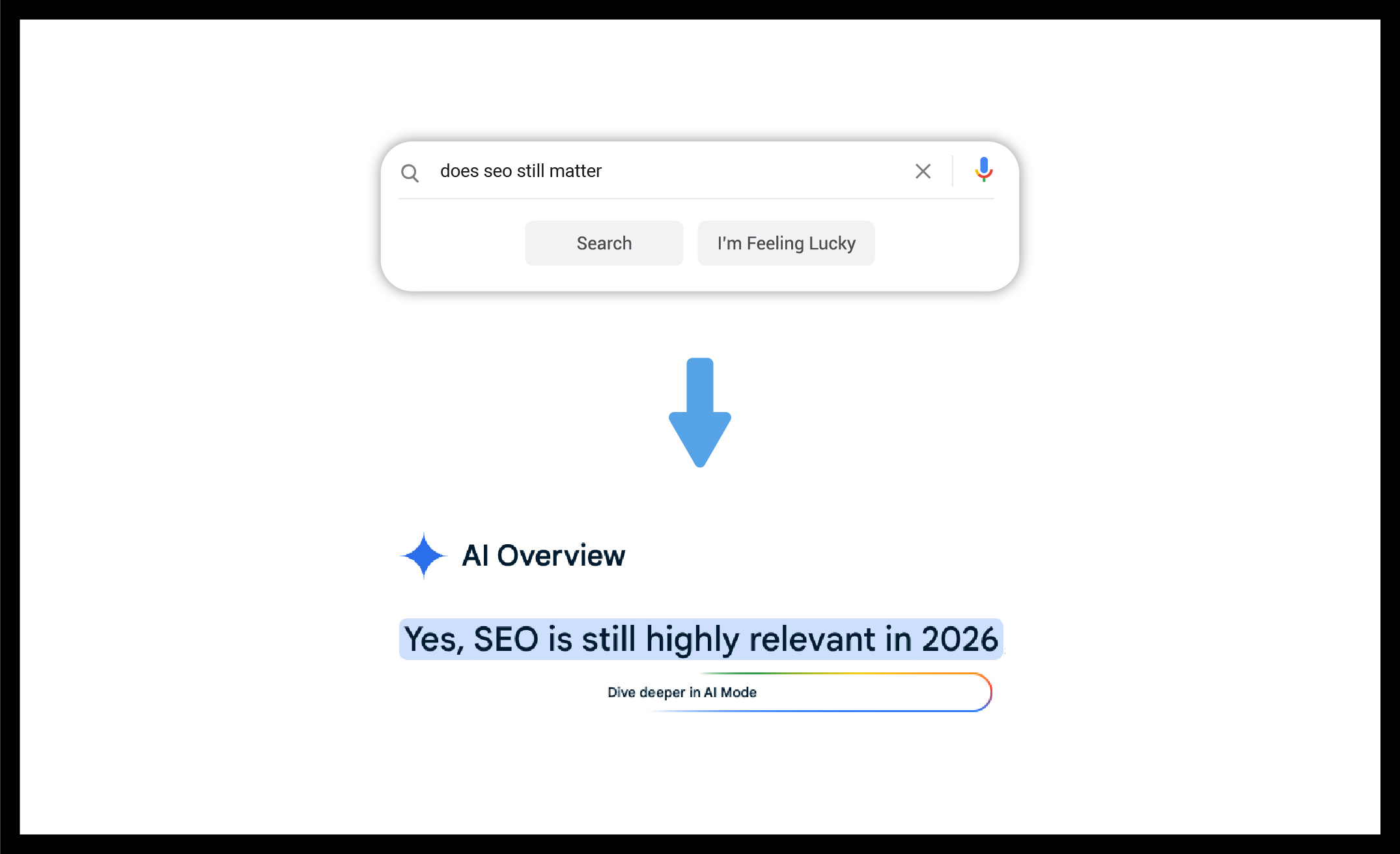
AI didn’t kill SEO. But it did change the rules. Here’s how we’re helping clients adapt.
If you’ve been following the headlines, you’d think search strategy is in its Wild West era—with AI riding in fast and rewriting the rules overnight.
“SEO is dead. Say hello to GEO”
“SEO is dead, GEO is king”
That’s the mood out there.
There’s some truth to it. Search is changing—and quickly.
But from where we sit, doing this work day in and day out, it’s less of a showdown and more of a shift.
Lately, our clients have been asking:
“How do we show up in ChatGPT?”
“Can we influence what AI tools say about us?”
“Is SEO still relevant?”
“Should we be doing GEO instead?”
Short answer: SEO still matters. A lot.
Longer answer: it’s now part of a bigger, more complex system.
Search isn’t just about ranking on Google anymore. It’s about whether—and how—your organization shows up when someone asks a question, whether that’s in a search bar, a voice assistant, or an AI tool generating a summary. AI isn’t replacing SEO—it’s changing how results show up.
New names, same job
You’ll hear a few acronyms:
SEO (Search Engine Optimization): making sure your site shows up in traditional search results—the familiar list of links. The original playbook.
AEO (Answer Engine Optimization): making sure your content is used to answer questions, like in featured snippets (such as the “People also ask” feature on Google) or voice responses.
GEO (Generative Engine Optimization): making sure AI tools (like ChatGPT, Gemini, or Claude) recognize and cite your content when generating answers.
Different names, but the same idea underneath it all: Are you findable? And are you understood?
One way we explain it to clients:
SEO gets your book on the shelf.
AEO helps your book show up as the answer.
GEO makes sure your book is one of the sources used to generate the answer.
All three matter now. And all three work together.

Start with how you’re showing up today
Even with all the change, the first step is surprisingly familiar: understand how you’re showing up today.
At Civilian, we start with what we call an AI audit. We look at what AI tools are actually saying about an organization—and where that information is coming from.
We test prompts and review the answers.
We look at what sources are cited—and whether they’re credible.
We map where a client is showing up (and where they’re not), from earned media to social content.
Then we step back and ask a bigger question: Is our client being understood correctly? Are its products and services accurately represented?
Because in an AI-driven environment, visibility isn’t just about traffic. It’s about accuracy, trust, and representation—especially for organizations working in public health, social impact, and other high-stakes spaces.
How this actually changes the work
A few things we’re guiding clients to do differently:
- Make information easy to extract. AI tools favor content that gets to the point. Clear answers. Clean structure. Less fluff.
- But don’t lose your voice. The goal isn’t robotic content—it’s human content that’s easy to understand and easy to use. And yes, the “let me tell you about my semester in Florence” preamble before a bolognese recipe still plays a role in traditional search; it helps with ranking.
- Write the way people ask. Search is becoming more conversational. That means your content should reflect real questions, not just keywords.
- Structure matters more than ever. Headers, subheaders, bullet points—these aren’t just for readability. They help AI systems interpret your content.
- And think beyond your website. Social content, captions, and subtitles are increasingly part of the search ecosystem, so include clear, extractable keywords in your posts.
- Stay consistent. The phrasing and keywords you use to describe your work should align across platforms. That consistency increases your credibility with both people and AI systems.
Why earned media matters more now
We’re seeing AI tools pull heavily from trusted news sources. That means communications strategy—what gets published, where, and by whom—is now directly tied to search visibility.
In other words, this isn’t just about your website anymore. It touches PR, content, and how clearly you show up overall.
What holds up, even as things change
The search strategy landscape is still changing rapidly—and at times, it does feel a little Wild West.
But underneath that, a lot of what matters hasn’t actually changed. The landscape is more complex, but also more connected—and that’s a good thing.
At the end of the day:
- People are still looking for clear, trustworthy information.
- They’re still asking questions.
- And they’re still trying to figure out what to do next.
To do that well requires being thoughtful about how content is created—and more ambitious about where it shows up, from owned channels to earned media.
AI visibility isn’t about chasing the algorithm. It’s about doing the foundational work well: being clear about who you are, what you do, and why it matters—and making sure that shows up consistently wherever people are looking.
Maybe that’s the irony: the more you optimize for machines, the more you’re pushed to be useful for humans.